

The business you are in affects the type of records you need to keep for federal tax purposes. Your recordkeeping system should include a summary of your business transactions. This summary is ordinarily made in your business books (for example, accounting journals and ledgers).
- The accounting method under which revenues are recognized on the income statement when they are earned (rather than when the cash is received).
- The statement of cash flows (or cash flow statement) is one of the main financial statements (along with the income statement and balance sheet).
- The realization principle dictates that revenue is only recognized when it’s realized, meaning that the goods or services have been delivered or performed.
- This period of time can be an accounting period of one year, six months, three months, or one month.
- The three financial statements are (1) the income statement, (2) the balance sheet, and (3) the cash flow statement.
- A common example is the revenue earned from the sale of goods and services.
Expense
Liquidity ratios measure a company’s ability to meet its short-term obligations using current assets on the balance sheet. They show how easily a business can convert assets into cash to pay bills, suppliers, and other near-term liabilities. Depreciation expense is recorded on the income statement to represent the decrease in value of fixed assets for the period. In some cases, a gain or loss may be recognized due to the disposal, transfer or impairment of fixed assets. As stated above, various methods may be used to calculate calculate depreciation for fixed assets. It depends on the petty cash nature of an organization’s business which method best reflects actual use and the decrease in value of their fixed assets.
When will I have access to the lectures and assignments?
Under the accrual accounting method, unearned revenue is recognized on the balance income statement definition sheet when received, even if the goods or services have not yet been provided. This method provides a more accurate picture of a company’s financial position and performance. Use this balance sheet to analyze a business’s financial health by comparing assets, liabilities, and owner’s equity. The template breaks down current, fixed, and other assets, plus current and long-term liabilities.
Optional cross-check: separating employee cash vs remittances

By using a “pyramid” of ratios, we can demonstrate how to determine the profitability, efficiency, and leverage drivers for any business. In this section of financial statement analysis, we will evaluate the operational efficiency of the business. We will take several items on the income statement and compare them to accounts on the balance sheet.
The amount of owner’s equity was determined on the statement of owner’s equity in the previous step ($16,850). If you take the total assets of Cheesy Chuck’s of $18,700 and subtract the total liabilities of $1,850, you get owner’s equity of $16,850. Using the basic accounting equation, the balance sheet for Cheesy Chuck’s as of June 30 is shown in Figure 2.9.

3 Prepare an Income Statement, Statement of Owner’s Equity, and Balance Sheet
A higher ratio means fixed assets are being used more adequately than a lower ratio. The fixed asset turnover ratio is best analyzed alongside profitability as it does not represent anything related to the company’s ability https://www.cryptorussian.top/?p=332 to generate profits or cash flows. The ending cash balance calculated on the cash flow statement (CFS) is the current period cash balance on the balance sheet. Net income also flows into the shareholders’ equity account via retained earnings, the cumulative net earnings to date kept by a company instead of issuing dividends to shareholders.
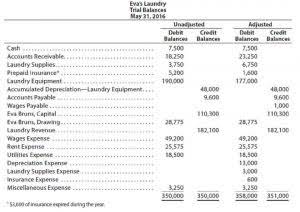
Revenues

Some examples of variable expenses include sales commissions, direct labor, inventory, etc. Another alternative to variable costing is absorption costing, where all manufacturing expenses are considered part of product costs. Click to download our free Microsoft Excel-based sample income statement template. Our financial statement template allows you full access to the Excel file to change the line item descriptions and is set to automatically tabulate your numbers.